








How Do You Localize Your Employer Branding Strategy for the US BFSI Sector?
US BFSI enterprise structures are changing with unprecedented speed, taking a toll on existing workforce engagement. According to the Robert Walters Talent Trends 2026 report, organizations worldwide are managing an "engagement recession", a phenomenon contributing to an estimated $438 billion in lost productivity.
If even your paid employees are getting restless, imagine trying to resonate with talent outside the organization.
Securing talent with specialized technical skills in newly expanded risk, compliance, or tech realms is a critical driver of business transformation and long-term corporate value. To consistently attract highly qualified, passive talent in the US BFSI sector, senior executives must develop their employer brand strategy beyond generic corporate positioning to one that resonates with the right local demographic, recognises their unique professional demands, and convinces them of their future with your organization.
What is Employer Branding Strategy?
An employer branding strategy is broadly an organization’s framework for managing and defining its reputation among current, potential, and former employees. In today’s talent market, this goes beyond passive corporate positioning, a strategic employer brand acts as a commercial lever that communicates a company's unique culture, values, and Employee Value Proposition (EVP), essentially answering why specialist talent should choose to work and stay with your organization.
In highly competitive or technical fields, such as American financial and fintech sectors, a generic brand fails to resonate, resulting in costly salary premiums, high attrition, and prolonged vacancies. Conversely, a mature, localized employer branding strategy positions you ahead of competitors while mitigating operational risks, insulating the business from talent shortages, and lowering long-term acquisition costs by building a scalable inbound pipeline of highly qualified, motivated professionals.
Benefits of Good Employer Branding
When competing for specialist talent in high-demand functions like risk, compliance and actuarial science, a well-defined employer brand is a critical headstart, creating sustained candidate interest even before roles are opened. Besides shortening time to hire, improving offer acceptance rates, and reducing the cost of attracting qualified candidates over time, an organization can expect boosts in employee retention by reinforcing their reasons to stay.
The derived commercial case is even more straightforward: organizations with a credible, consistently communicated employer brand spend less to hire better people, more quickly.
This is however contingent on effective localization. Employer branding campaigns that do not extend beyond generic corporate value statements will fail to resonate with regional or sector-specific talent pools. A global brand strategy designed at a corporate headquarters in London, for example, rarely addresses the specific motivations of operational risk leaders in regional financial hubs in Birmingham or Edinburgh.
Examples of Employer Branding
Employer branding in US banking and financial services industries can take many forms, but the most effective approaches directly target candidate expectations. Driven by regulatory shifts and modern employee expectations, top professionals increasingly prioritize corporate trust, transparency, defined progression, and metrics beyond traditional compensation structures.
The Robert Walters Salary Survey 2026 highlights that American BFSI professionals rank enhanced wellbeing strategies, compensation and benefits, and flexible working as their top considerations. A targeted US employer branding strategy would therefore directly address pay clarity, adjacent physical and mental health initiatives, and appropriate work arrangement models to attract its best specialists.
Furthermore, as financial institutions invest heavily in fintech integration and cloud architecture, you’re not just competing with other banks, but also major technology firms for data scientists and software engineers. A different candidate profile demands different priorities, and therefore your employer brand must actively showcase investments in areas like cutting-edge infrastructure, structured technical development, and clear upskilling pathways.
Whether you seek to attract early careers talent for highly technical skillsets, or experienced industry veterans to fast-track time-sensitive projects, good employer branding will demand process consistency: the same proposition communicated credibly across candidate touchpoints, from job advertisements and career sites through to the recruitment process and onboarding experience itself.
How do you develop a localized employer branding strategy?
Developing a localized employer branding strategy requires a systematic approach that orchestrates central corporate governance alongside local execution, guided by deep market and competitor research.
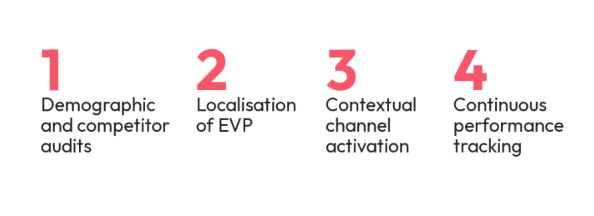
Step 1: Demographic and competitor audits
Here, you will seek to identify regional talent groups and their key demands. As discussed previously, needs and expectations vary significantly between industry lines.
On top of this, knowing what competitors are also doing will be key to shaping your way forward. There is much to learn from established incumbents and new fast-growing market entrants – not just their methodology, but also metrics like hiring hotspots and job experience variance, and your task is to take that information and adapt accordingly.
Step 2: Localization of EVP
With your core brand values as the base, you now translate global corporate ethos to regionally relevant commitments. Quantify and justify as needed. For example,
Global message: professional career growth
Local adjustment: support for regional certifications and regulatory upskilling
Global message: flexible working
Local adjustment: locally competitive hybrid arrangements, parental and childcare leave policies
“In competitive hiring markets, the strongest organizations stand out by treating applicants the way great brands treat customers: with care, clarity, and experiences built around the candidate, not internal processes.”
Isla Smith, Global Head of CX, Robert Walters
Step 3: Contextual channel activation
Now that your localized setup is ready, the next step is deployment. The media mix must complement the candidate profile. While traditional methods like job boards and paid media do well with specific audiences, explore alternative ideas that get you in front of niche talent populations. Think graduate and postgraduate fairs, industry events, social media, and organic talent networks – be warned, however, that these solutions each have drawbacks when deployed in isolation.
Step 4: Continuous performance tracking
Launching your employer brand campaign is just the beginning, and real-time data will help future iterations engage and convert better. Basic top-of-funnel metrics like raw application volume, while potentially inflated by AI, could signal uncharted talent pools, while data further down the funnel like applicant quality, interview-to-offer ratios and regional time-to-fill will continue to shape the efficacy of candidate attraction.
Operationalizing your strategy via Recruitment Process Outsourcing (RPO)
Managing distinct, localized brand messaging across multiple sites can place a significant strain on internal HR and Talent Acquisition departments. This operational complexity is a primary reason why business transformation leaders choose to partner with specialized enterprise providers.
When looking for a partner, it is important that they can reconcile your organization’s talent objectives, the proposed employer branding strategy shaped to target said objectives, and the data and insights utilized to reach these conclusions.
Alongside your day-to-day recruitment operations, an RPO partner with an eye on your long-term talent strategy should also possess:
- Talent market intelligence: RPO teams utilize advanced analytics to provide real-time salary benchmarking, regional talent mapping, and competitor brand analysis across the US market.
- Content and proposition marketing: Utilizing deep expertise in tailored marketing solutions, partners can design and execute brand campaigns tailored to your specific regional, demographic, or technical requirements.
- Application volume management: In an environment where generative AI tools allow candidates to submit high volumes of generic applications, an experienced RPO partner reinforces human judgment, selecting genuine high-quality, aligned applicants rather than simply increasing raw volume.
Your employer branding strategy should support your commercial objectives
In a highly competitive hiring market, businesses that fail to localize their employer brand strategy risk falling behind. However, when done right, the benefits of localized, nuanced employer branding will go beyond short-term improvement of applicant quality and reduced time-to-fill. Our webinar on-demand, Winning talent in APAC: employer brand in the age of AI, brings together our suite of talent marketing experts and partners to quantify the costs and benefits of employer brand initiatives in the APAC region. Alternatively, if you are ready to evaluate your recruitment and build a scalable inbound pipeline of motivated, empowered professionals, reach out to us and have our strategic talent advisors diagnose and consolidate your regional talent strategy.
Meet our expert RPO team

Chris Eldridge
CEO UKI & North America
With over 20 years’ experience in professional services recruitment, half of which has been spent in leadership positions, Chris brings deep expertise in UK, North American, and European hiring markets. As CEO, he has driven innovative strategies that have shaped recruitment practices globally. His insights into talent acquisition trends and leadership development make him a sought-after commentator on workforce evolution.

Dawn Sloan
Operations Director, North America
Dawn oversees operational delivery, governance, and performance for our North America client portfolio, driven by a passion for customer experience, innovation, and continuous improvement.
FAQs
-
Why does generic employer branding fail to attract talent?
Standardised corporate branding lacks the specificity needed for regional talent pools. When compared to a competitor that actively localizes and revises their EVP, your firm may have to pay a premium to attract the same talent, suffer higher employee turnover when said specialists realise the disconnect between your global brand and local reality, and and ultimately face poorer time-to-fill metrics and delayed business objectives. -
What are the primary workplace motivators for American BFSI candidates?
Modern US finance specialists look for corporate integrity, transparency, and clear career progression. Their top priorities include wellbeing programmes, transparent compensation, and hybrid working models. Additionally, because financial firms now compete with major tech companies for digital talent, your brand must explicitly showcase investments in advanced technology infrastructure and technical upskilling pathways. -
What are some model examples of employer branding localization?
The most effective localized EVPs consider the target candidate groups’ region- and industry-specific demands. Accounting for local candidate motivations can look something like this:
- Shifting a global message of "continuous career growth" to a local promise of "funding for UK regulatory certifications and compliance upskilling."
- Refining a broad "flexible working" policy into "locally competitive hybrid structures, enhanced parental leave, and localized childcare support initiatives."
-
How can an outsourcing provider help with an employer's EVP?
Balancing unique regional messaging overburdens internal talent teams. A Recruitment Process Outsourcing (RPO) partner scales this complex process by providing localized market intelligence and bespoke talent marketing campaigns. On top of this, an RPO partner can also manage the rest of the recruitment process, including screening for genuinely qualified talent amid an explosion of AI-generated CVs.
Related content
View All
Candidate experience is fast becoming the key to gaining the competitive edge in the talent marketplace. In recent years, customer experience has become a key focus among businesses, with almost half of business leaders viewing it as a top priority for the next 5 years. There is no doubt that consum
Read More
Welcome to the world of nurture. Marketers have been using it for years to communicate with interested leads, influence the buyer’s journey and convert them into customers. Why should the candidate experience be any different? Robert Walters' Candidate Experience in the Expectation Economy research
Read More
Robert Walters worked with a leading European bank to overcome their challenge to recruit for their anti-financial crime department. They were faced with a combination of attrition and regulatory headcount requirements. The company’s strategic shift to trialing a remote working pilot as a result of
Read More