.png)








The AI Salary premium: Market outlook and strategic implications for the US
The AI hiring market in 2026 has split in two. On one side, a “great recalibration” has ended the speculative hype hiring of 2023-2024. On the other, the salaries for verified AI skill keeps climbing, faster than almost any other category in the US labor market.
The AI talent conversation has focused on new roles such as AI Engineers, Machine Learning Scientists, and AI Product managers. However, a more significant shift is occurring beneath the surface. Across industries, employers are increasingly paying a premium for professionals who combine traditional expertise with AI capabilities.
This article details the AI salary premium across high-demand roles, and what it means for employers building AI capability in 2026.

The shift in AI hiring

Key highlights
- The average wage premium for workers with AI skills in the US has risen to 62% in 2026, up from 57% in 2025, according to PwC’s Global AI Jobs Barometer.
- AI/ML engineers earn a national median of roughly $170,000-$175,000, with senior specialists at $200,000-$310,000 in base pay, before equity.
- The wage premium is far from uniform: it runs as high as 118% in consumer markets and as low as 16% in government and public sector roles as per PWC 2026 report.
- Geography still matters, but less than it used to. The Bay Area/New York City pay premium over national remote bands has compressed from a typical 25-35% gap pre-2023 to roughly 10-15% today
- Specialization, not job title, is now the primary driver of pay. LLM fine-tuning and AI safety/alignment specialists earn 25-45% above generalist ML engineers.
US AI wage premium
According to PwC’s 2026 Global AI Jobs Barometer, which analysed over a billion job ads across six continents, AI-skilled professionals in the US commanded an average wage premium of 62% in 2026, up from 57% the year before.
The premium is not evenly spread. It ranges as high as 118% in sectors such as consumer markets, and as low as 16% in government and public sector work. Jobs explicitly requiring AI skills are also growing around eight times faster (69%) than the overall jobs market (9%).
This is a structural shift, not a one-year spike. PWC’s prior-year barometer had already flagged this trajectory, reporting a near-quadrupling of productivity growth in AI-exposed industries such as financial services and software publishing since GenAI’s adoption began in 2022.
PWC’s 2026 release goes further: companies most exposed to AI are now growing headcount and wages faster than the rest of the market, not slower. Headcount growth at the most AI exposed companies is running at 52% versus 36% for the least exposed, and wage growth at 24% versus 17%.
The AI premium effect
In previous technology cycles, this pattern was seen in cloud computing, cybersecurity, and data science. In 2026, AI has become the latest catalyst. Organisations are no longer seeking AI specialists alone; they increasingly require professionals who can embed AI into business functions, manage AI risk, improve decision-making, and automate workflows.

AI-augmented talent commands higher compensation
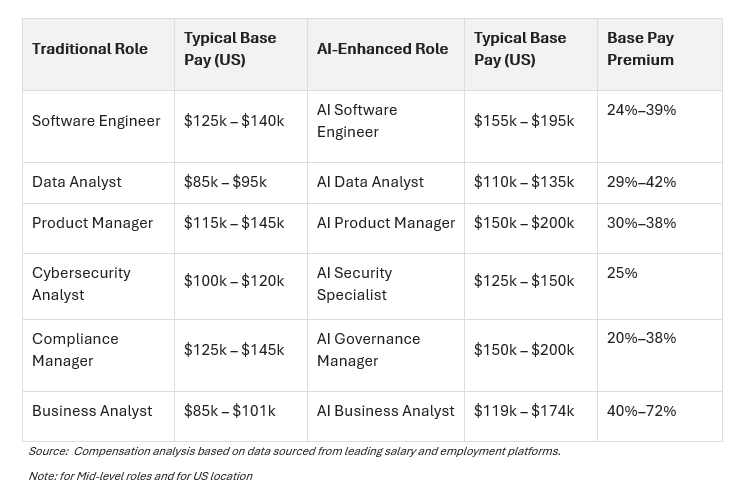
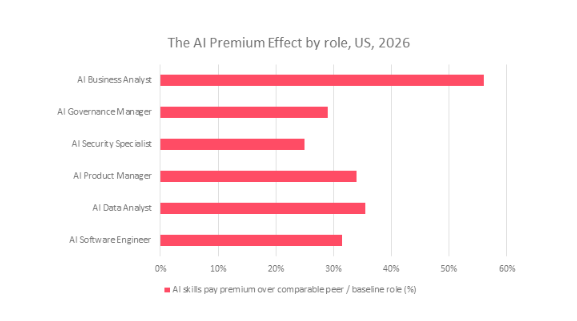
The pattern is consistent across every indicating that professionals with AI skills are paid a premium relative to an otherwise-identical peer without those skills, with the size of the premium driven by how scarce AI-literate talent is within that function relative to how quickly employer demand for it is growing.
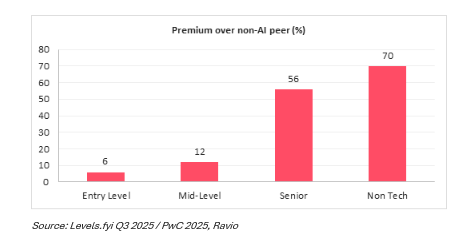
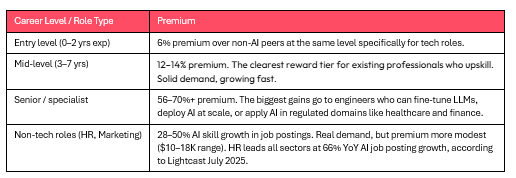
AI premium by level
Why does the AI premium exist?
- Demand outpaces supply: AI-related job demand is projected to exceed 1.3 million roles over the next two years, while the available talent pipeline is expected to meet fewer than 645,000 of these positions. As a result, nearly 700,000 workers in the U.S. may require reskilling to address the anticipated talent gap.
- Ability to attract global AI talent is declining: The United States remains the global leader in AI investment, although its ability to attract international AI talent is weakening. In 2025, private AI investment in the U.S. reached $285.9 billion, more than 23 times Mainland China's $12.4 billion. However, comparing private investment alone may underestimate Mainland China's overall AI spending due to significant government-backed funding initiatives. The U.S. also maintained its lead in AI entrepreneurship, with 1,953 newly funded AI startups in 2025, over ten times more than any other country. Despite this strength, the inflow of AI researchers and developers to the U.S. has fallen sharply, declining by 89% since 2017 and by 80% in the past year alone, according to the 2026 AI Index Report by Standford.
Does the AI premium affect wage compression?
The Bay Area and New York City has narrowed considerably. Remote-first employers that benchmark compensation against national U.S. salary bands now typically offer packages only 10–15% below San Francisco-based roles, compared with the 25–35% differential commonly seen before 2023. Meanwhile, cities such as Austin, Seattle, and Boston have emerged as key reference points for Tier 2 U.S. compensation structures.
Will premiums stabilize?
The AI wage premium shows no sign of stabilizing, rising from 25% in 2023 to 62% in 2025, per PWC's 2026 Global AI Jobs Barometer of over one billion job ads, with sector spreads ranging from 118% in consumer markets to 16% in government. Non-tech is catching up fast 51% of AI job postings are now outside IT, with demand surging across marketing, finance, and operations. Looking ahead, Gartner projects AI will create more jobs than it destroys by 2028, though 80% of the engineering workforce will need upskilling by 2027 suggesting premiums will persist for those who adapt and widen for those who don't.
What employers should consider about the AI premium
- Stop benchmarking against frontier-lab headlines. $600K+ total compensation at OpenAI or Anthropic is real but is not the relevant comparator for mainstream enterprise hiring. Use mid-market benchmarks ($170K-$230K base) for budgeting, and reserve frontier comparisons only for roles genuinely competing in that tier.
- Price the cost of underpaying, not just the salary line. Falling below the $200,000 senior base floor correlates with 114-day average time-to-fill 40-50% longer than competitive offers, which carries its own delivery and opportunity cost.
- Pay for specialization, not job titles. LLM fine-tuning, AI safety/alignment, and production MLOps experience carry quantifiable premiums (25-45%) over generalist AI/ML roles. Blanket “AI engineer” pay bands risk both overpaying generalists and losing specialists to counteroffers.
- Sector exposure changes the right anchor point. A consumer markets AI premium (118%), and a public-sector AI premium (16%) are not the same market, benchmarking should be sector-specific, not a single national average.
Conclusion
The AI salary premium in the US has moved past the “is this a bubble” debate and settled into a structural feature of the labour market: a 62% average wage premium for AI-skilled workers, a widening gap between AI-exposed and non-AI-exposed industries, For employers, the risk in 2026 isn’t overpaying for AI talent broadly; it’s misallocating budget by relying on a single source of information on salary as opposed to understanding differences by region and/or specialization.
Related content
View All
Given a complex labour market and talent landscape, industry-specific compensation and benefits benchmarking is crucial to attract and retain top talent. At its core, compensation benchmarking is the process of comparing an organisation’s pay practices against external market data to ensure competit
Read More
In today's dynamic job market, staying informed about industry trends, talent supply, and competitor strategies is crucial for making effective hiring decisions. This is where recruitment market analysis comes in. By leveraging market insights, you can adapt to changes in the hiring landscape, antic
Read More
In the fast-paced world of recruitment, having access to accurate, real-time data about the talent market can make all the difference in sourcing top candidates. This is where talent market intelligence comes into play. By leveraging comprehensive insights about the job market, candidate behaviour,
Read MoreFAQs
-
What information is included in a Robert Walters compensation benchmarking report?
Each benchmarking report provides a clear summary and detailed analysis of your organisation’s pay structures compared to market standards. Every report is tailored to your specific brief and typically includes market salary and benefits data; skills and position comparisons; competitor data; and insights segmented by industry, region, and company size to ensure relevance to your business.
Importantly, our reports include tailored advice on how to optimise your compensation strategy to overcome any market challenges, such as inflation, while improving your competitiveness.
-
What specific roles or levels can I benchmark within my organisation?
Compensation benchmarking can be applied to most roles for which there is market data, from manager level to C-suite executives. Benchmarking is particularly valuable for roles that are difficult to fill, rapidly evolving, or critical to your strategic goals.
For organisations with unique or hybrid roles, we provide tailored benchmarking by identifying comparable positions across the industry to ensure you’re aligning pay and benefits appropriately, even in niche areas.
-
Can you help me align my compensation strategy with industry trends?
Yes, salary benchmarking doesn’t just provide data—it informs strategy. We help you align your pay and benefits practices with emerging trends, such as the increasing emphasis on performance-based pay, flexible benefits, and equity or incentive structures.
By understanding market dynamics and employee expectations, we guide you in creating a compensation strategy that positions your organisation as an employer of choice, while supporting your long-term business goals.